
1. Workspace Setup and Architecture
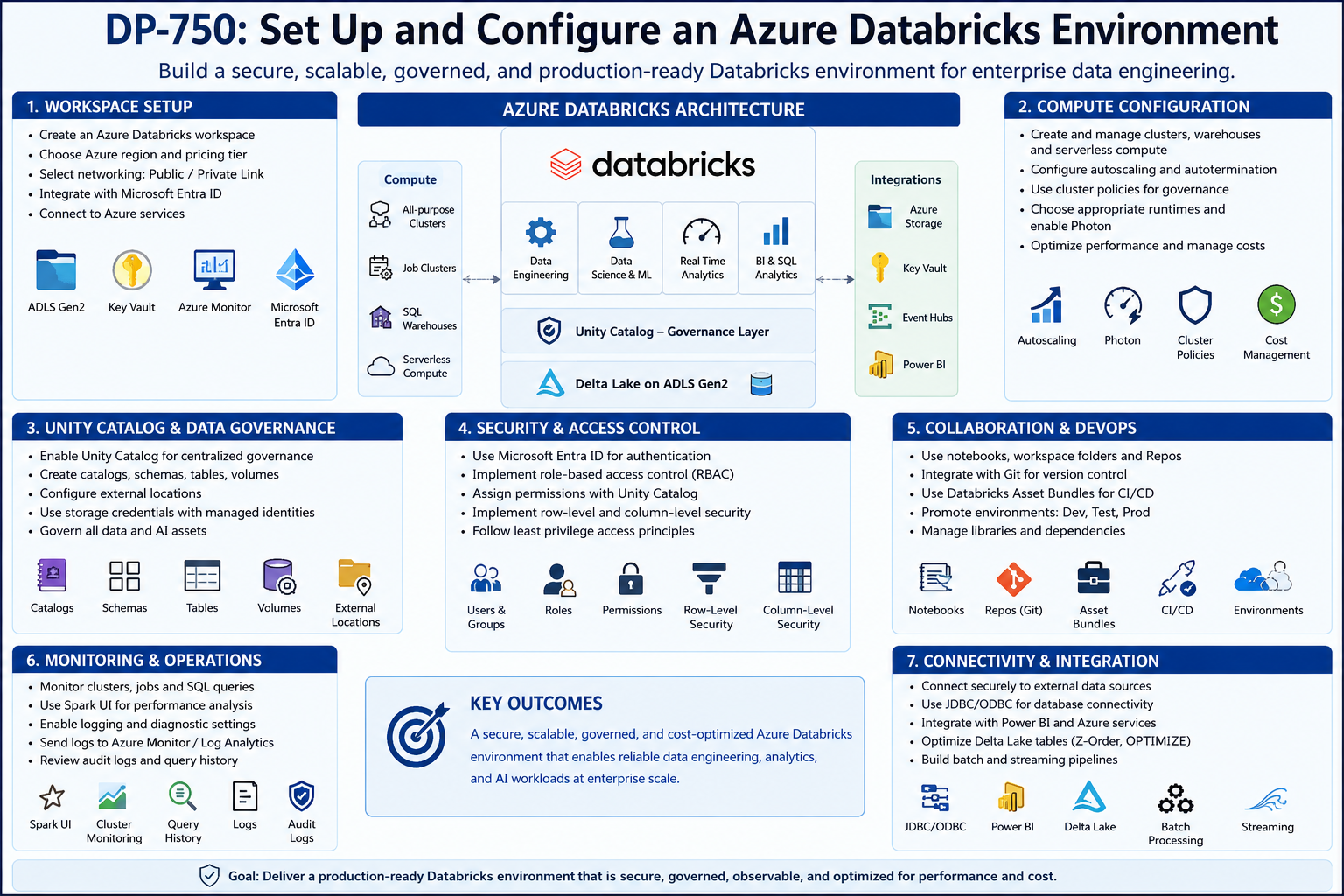
This area focuses on creating and configuring Azure Databricks workspaces within Microsoft Azure. Candidates should understand Azure region selection, pricing tiers, networking models, and integration with services such as Azure Data Lake Storage Gen2, Azure Key Vault, Azure Monitor, and Microsoft Entra ID. Knowledge of how Azure Databricks supports modern lakehouse architectures and scalable Spark-based processing is also important.
2. Compute Configuration and Performance Optimization
Candidates must understand how to configure and manage compute resources including all-purpose clusters, job clusters, SQL warehouses, and serverless compute. This includes autoscaling, autotermination, cluster policies, runtime management, and Photon acceleration. Data engineers should also understand workload optimization, cost management, and selecting the correct compute type for notebooks, pipelines, streaming, machine learning, and SQL analytics workloads.
3. Governance, Security, and Unity Catalog
A major focus of DP-750 is implementing governance and security using Unity Catalog. Candidates should understand how to organize catalogs, schemas, tables, volumes, and external locations. They must also know how to configure managed identities and storage credentials securely. Security topics include role-based access control, permissions management, row-level and column-level security, dynamic views, and applying least-privilege access principles to support compliance and data protection.
4. Collaboration, Monitoring, and Integration
This section covers workspace administration, collaboration, monitoring, and integration capabilities. Candidates should understand notebooks, Git integration, Repos, Databricks Asset Bundles, and CI/CD deployment processes across development, test, and production environments. Monitoring topics include logging, audit logs, diagnostic settings, cluster monitoring, and Spark UI analysis for troubleshooting performance issues such as skew, shuffle, and spill. Candidates should also understand integration with external data sources, JDBC/ODBC connectivity, Power BI, Delta Lake optimization, and structured streaming solutions.
Links
Microsoft Certified: Azure Databricks Data Engineer Associate – Certifications | Microsoft Learn